Helping Attentive customers turn texts into conversations that convert

tl;dr

Problem

Customers wanted real conversations with their text subscribers β€” not one-way blasts β€” but none had the bandwidth to staff people to reply in real-time.

Results

Clients who used conversation data for targeting saw πŸš€ a 23% lift in click-through rate and 6% lift in revenue over generic messaging.

Solution

A guided, automated system that let customers ask targeted questions and act on the replies, no headcount required.

My behavior
  • Anchored the opportunity in survey data and a competitive gap analysis
  • Helped resolve the automation-vs-human-agent debate with a confidence/impact/risk framework
  • Used customer interviews to catch our biggest blind spot: guidance, not control
  • Scoped the MVP through affinity mapping, then validated it before rollout
Defining the problem

At Attentive, I was the lead product designer on the Journeys team, partnering with a PM and engineers to expand our one-way texting product into two-way, automated conversations.

​

Leadership wanted proof that a conversational product could move revenue. Rather than start from a blank page, I looked for evidence the demand already existed.

​

Before we built anything, 20 clients had already started hacking together two-way conversations using an internal keyword feature never designed for it β€” the clearest signal we had that this wasn't hypothetical. A survey of 400 customers confirmed it: high interest in conversion-driving use cases, but no bandwidth to run it manually.

​

A competitive gap analysis showed the market agreed β€” competitors had shipped self-service conversational tools, but all shallow. The opportunity was open.

Competitive feature comparison table across Attentive, SMS Bump, Emotive, Tone, and Core ESPs showing Attentive slightly behind in the market when it comes to shallow conversational automated features.

Diverging on solutions

I ran a cross-functional workshop to pressure-test how we could get to signal fast, with minimal lift from customers.

​

The open question: automate, or staff it with human agents? Agents would likely convert better β€” but automation would get us broader, faster signal with fewer dependencies. Alongside the PM, we scored both against confidence, impact, and risk, and used that to align stakeholders quickly: start automated, leave room to test human-assisted later.

​

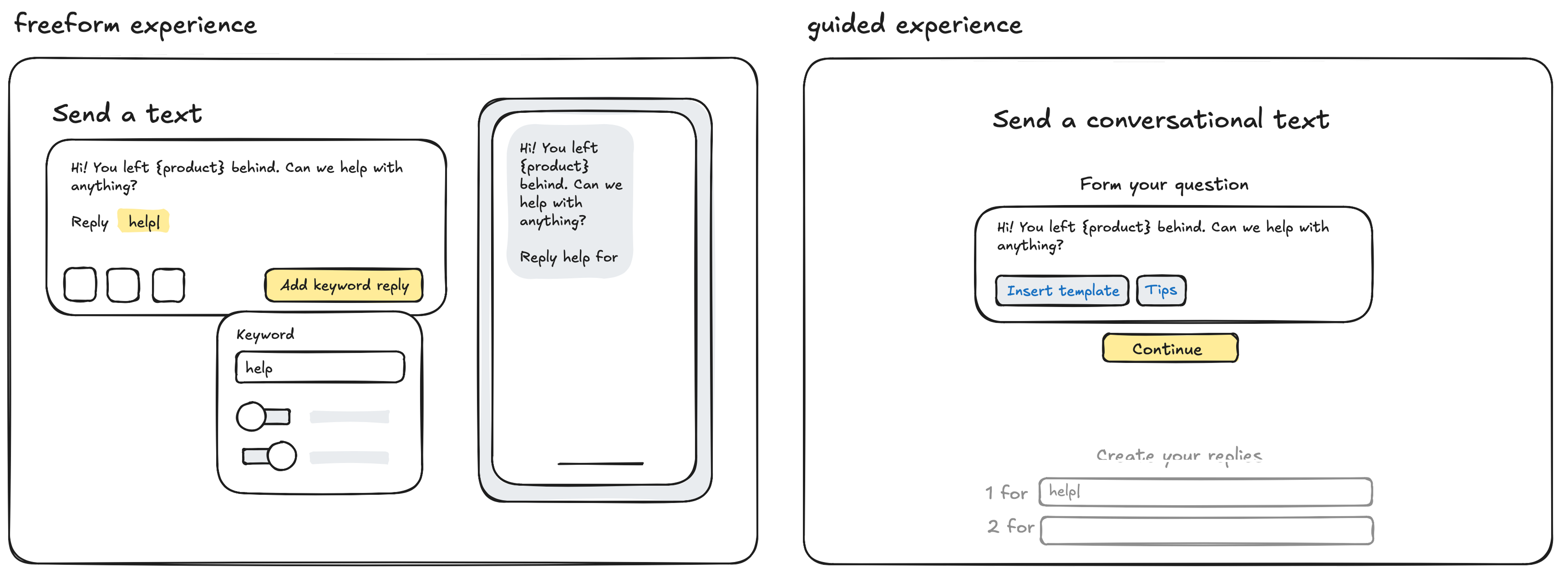
As I sketched out ideas, I noticed they all varied along the same question: how guided should the experience be? Directions ranged from a fully freeform conversation builder to a more guided, templated approach.

Wireframe comparison of freeform vs. guided SMS message composition experiences showing different approaches to configuring conversational texts

I interviewed 5 customers β€” 4 from our core persona, 1 super-user β€” to pressure-test our assumptions about how much guidance people actually wanted.

β€œI think you all have a better idea on best practices and standards for these texts, so I’d want to be helped along the way, maybe like tips or templates…”

​

β€” Marketing Manager

The takeaway: there's no single mental model for how people want to configure messages, but a few smart guardrails were welcomed, not resented.

Converging on solutions

I ran an affinity mapping session with product and engineering to convert those insights into MVP scope β€” message-crafting fundamentals first, subscriber-frequency logic as a fast follow.

Whiteboard mockup of Musts, Shoulds, Coulds and Wonts

I refined hi-fi designs into a clickable prototype built around a flexible mad-lib structure β€” better defaults for clients, structured data for us. That structure was built to support suggesting higher-performing questions and replies by industry and goal as we scaled.

UI mockup showing a conversational text message builder with question and reply configuration, and a real-time phone preview of the subscriber experience

Reply formatting guardrails kept messages clear without limiting flexibility. A real-time preview showed clients exactly what subscribers would see β€” grounding every decision in their audience's perspective, not their own.

One usability finding shaped a late tweak: as a step saved, the map subtly shifted to bring replies into view, with a one-time tooltip guiding setup. In lo-fi testing, users were occasionally unsure where β€” or whether β€” they'd already configured their replies, which is what drove that fix.

Results and next steps

After usability testing and a few tweaks, we rolled the MVP out to 20 customers with specific use cases.

​

A little over a month later, we found that incentivizing a reply performed just as well as incentivizing a click to the website β€” letting customers gather valuable targeting data "for free" through replies.

One client who used that data for targeting saw a

23% lift in click-through rate and a 6% lift in revenue over generic messaging.

Priase and validation from our customers regarding the vonversational tool we launched

Next steps I’d have considered:

​

  • Widen the rollout: Test the retargeting win against more use cases and a broader set of clients before calling it validated
  • Systemize the win: Turn the reply-incentive pattern into a repeatable template, not something clients discover on their own
  • Revisit human agents: With automation now proving out demand, decide if the higher-touch tier is worth building

Say hello!

Helping Attentive customers turn texts into conversations that convert

tl;dr

Problem

Customers wanted real conversations with their text subscribers β€” not one-way blasts β€” but none had the bandwidth to staff people to reply in real-time.

Results

Clients who used conversation data for targeting saw πŸš€ a 23% lift in click-through rate and 6% lift in revenue over generic messaging.

Solution

A guided, automated system that let customers ask targeted questions and act on the replies, no headcount required.

My behavior
  • Anchored the opportunity in survey data and a competitive gap analysis
  • Helped resolve the automation-vs-human-agent debate with a confidence/impact/risk framework
  • Used customer interviews to catch our biggest blind spot: guidance, not control
  • Scoped the MVP through affinity mapping, then validated it before rollout
Defining the problem

At Attentive, I was the lead product designer on the Journeys team, partnering with a PM and engineers to expand our one-way texting product into two-way, automated conversations.

​

Leadership wanted proof that a conversational product could move revenue. Rather than start from a blank page, I looked for evidence the demand already existed.

​

Before we built anything, 20 clients had already started hacking together two-way conversations using an internal keyword feature never designed for it β€” the clearest signal we had that this wasn't hypothetical. A survey of 400 customers confirmed it: high interest in conversion-driving use cases, but no bandwidth to run it manually.

​

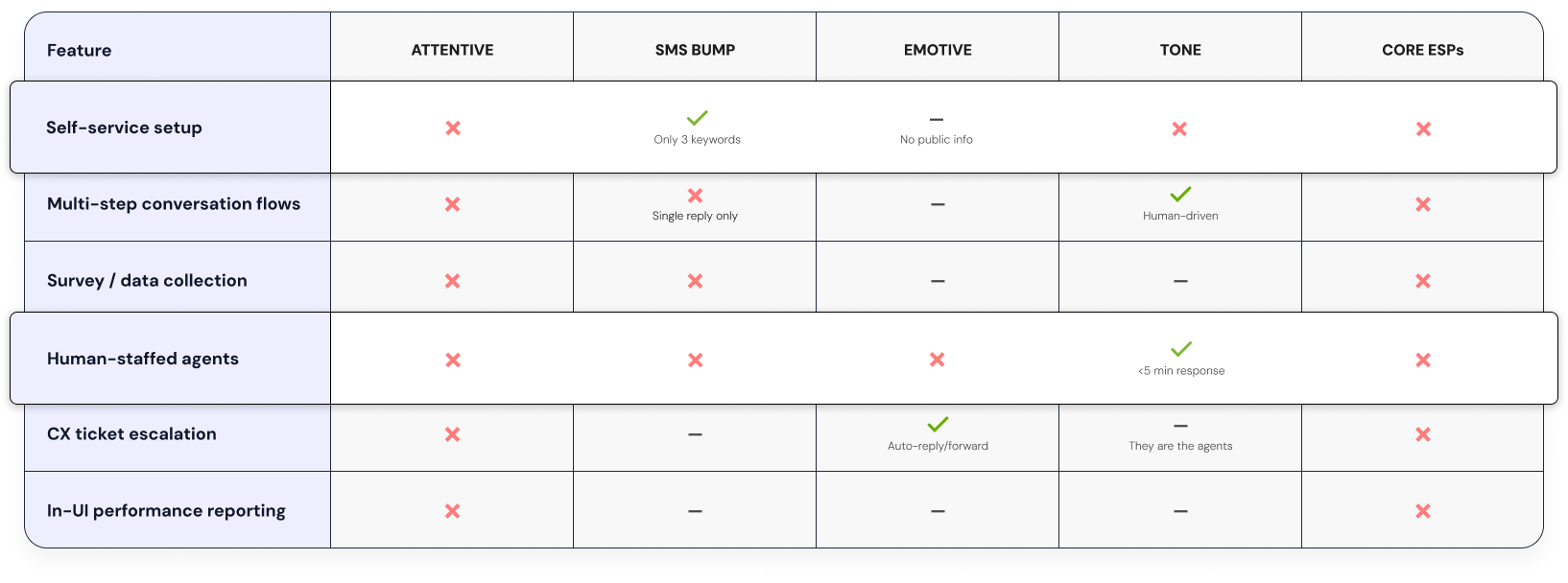
A competitive gap analysis showed the market agreed β€” competitors had shipped self-service conversational tools, but all shallow. The opportunity was open.

Competitive feature comparison table across Attentive, SMS Bump, Emotive, Tone, and Core ESPs showing Attentive slightly behind in the market when it comes to shallow conversational automated features.

Diverging on solutions

I ran a cross-functional workshop to pressure-test how we could get to signal fast, with minimal lift from customers.

​

The open question: automate, or staff it with human agents? Agents would likely convert better β€” but automation would get us broader, faster signal with fewer dependencies. Alongside the PM, we scored both against confidence, impact, and risk, and used that to align stakeholders quickly: start automated, leave room to test human-assisted later.

​

As I sketched out ideas, I noticed they all varied along the same question: how guided should the experience be? Directions ranged from a fully freeform conversation builder to a more guided, templated approach.

Wireframe comparison of freeform vs. guided SMS message composition experiences showing different approaches to configuring conversational texts

I interviewed 5 customers β€” 4 from our core persona, 1 super-user β€” to pressure-test our assumptions about how much guidance people actually wanted.

β€œI think you all have a better idea on best practices and standards for these texts, so I’d want to be helped along the way, maybe like tips or templates…”

​

β€” Marketing Manager

The takeaway: there's no single mental model for how people want to configure messages, but a few smart guardrails were welcomed, not resented.

Converging on solutions

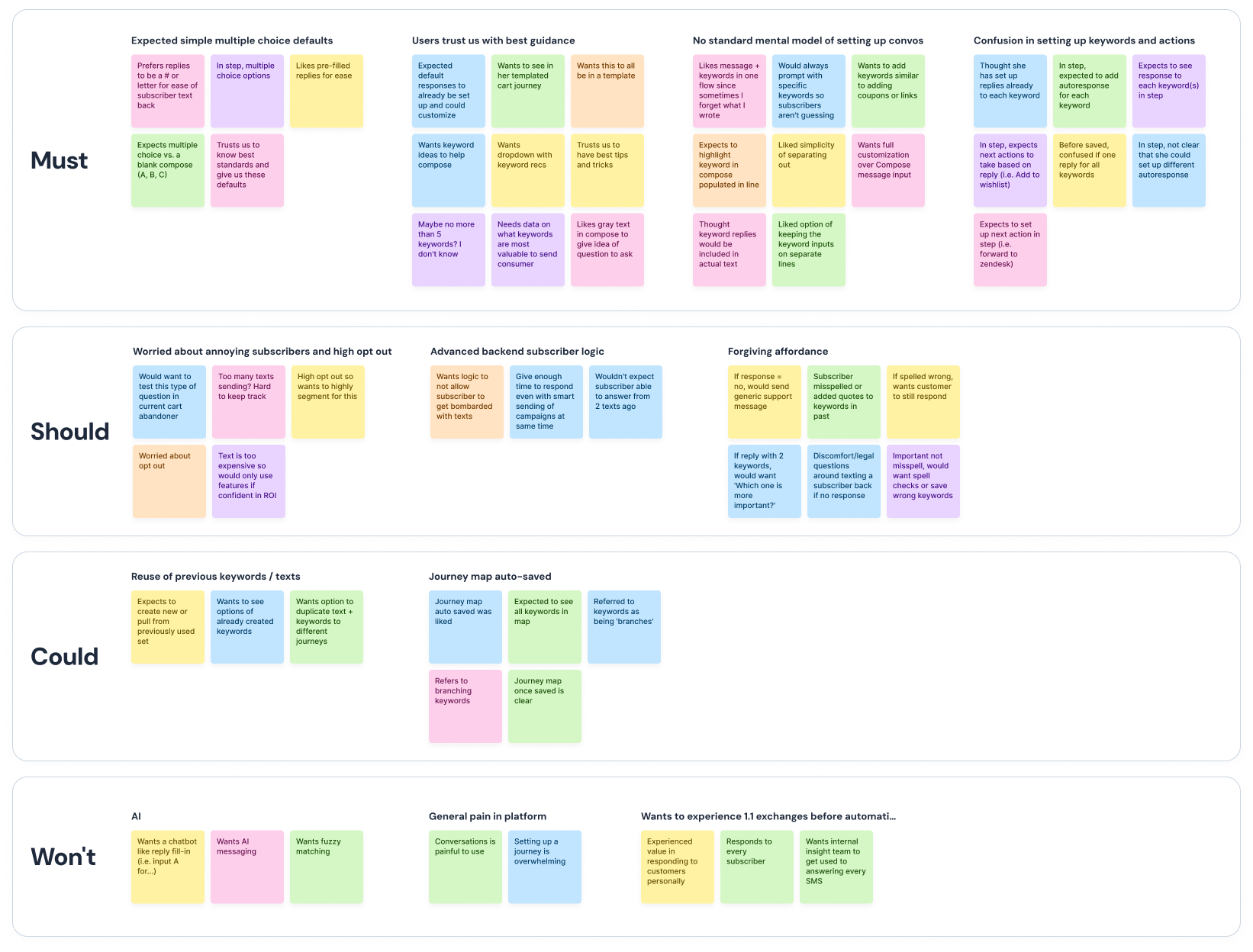
I ran an affinity mapping session with product and engineering to convert those insights into MVP scope β€” message-crafting fundamentals first, subscriber-frequency logic as a fast follow.

Whiteboard mockup of Musts, Shoulds, Coulds and Wonts

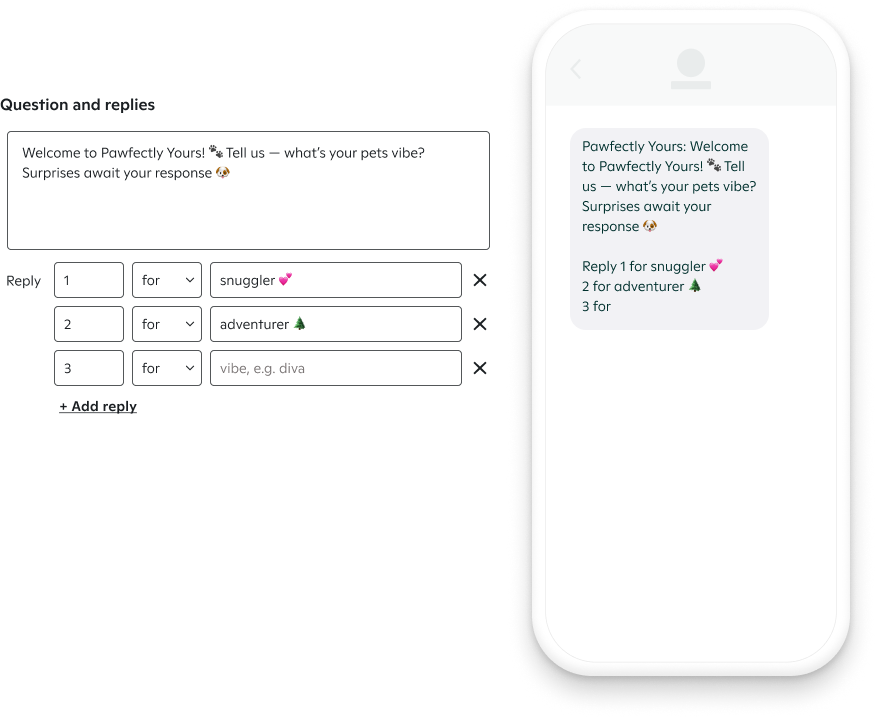
I refined hi-fi designs into a clickable prototype built around a flexible mad-lib structure β€” better defaults for clients, structured data for us. That structure was built to support suggesting higher-performing questions and replies by industry and goal as we scaled.

UI mockup showing a conversational text message builder with question and reply configuration, and a real-time phone preview of the subscriber experience

Reply formatting guardrails kept messages clear without limiting flexibility. A real-time preview showed clients exactly what subscribers would see β€” grounding every decision in their audience's perspective, not their own.

One usability finding shaped a late tweak: as a step saved, the map subtly shifted to bring replies into view, with a one-time tooltip guiding setup. In lo-fi testing, users were occasionally unsure where β€” or whether β€” they'd already configured their replies, which is what drove that fix.

Results and next steps

After usability testing and a few tweaks, we rolled the MVP out to 20 customers with specific use cases.

​

A little over a month later, we found that incentivizing a reply performed just as well as incentivizing a click to the website β€” letting customers gather valuable targeting data "for free" through replies.

One client who used that data for targeting saw a

23% lift in click-through rate and a 6% lift in revenue over generic messaging.

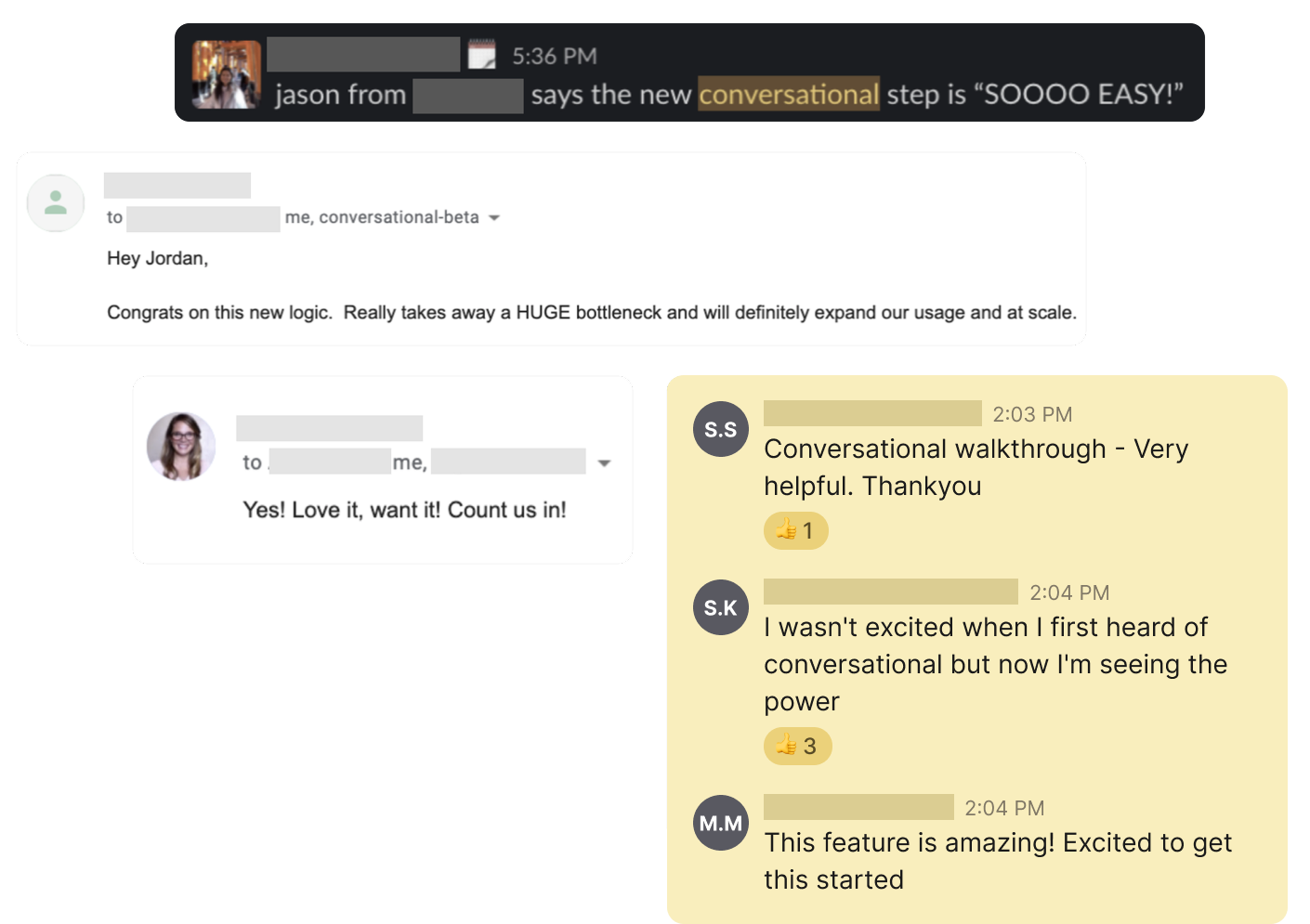
Priase and validation from our customers regarding the vonversational tool we launched

Next steps I’d have considered:

​

  • Widen the rollout: Test the retargeting win against more use cases and a broader set of clients before calling it validated
  • Systemize the win: Turn the reply-incentive pattern into a repeatable template, not something clients discover on their own
  • Revisit human agents: With automation now proving out demand, decide if the higher-touch tier is worth building

Say hello!

Helping Attentive customers turn texts into conversations that convert

tl;dr

Problem

Customers wanted real conversations with their text subscribers β€” not one-way blasts β€” but none had the bandwidth to staff people to reply in real-time.

Results

Clients who used conversation data for targeting saw πŸš€ a 23% lift in click-through rate and 6% lift in revenue over generic messaging.

Solution

A guided, automated system that let customers ask targeted questions and act on the replies, no headcount required.

My behavior
  • Anchored the opportunity in survey data and a competitive gap analysis
  • Helped resolve the automation-vs-human-agent debate with a confidence/impact/risk framework
  • Used customer interviews to catch our biggest blind spot: guidance, not control
  • Scoped the MVP through affinity mapping, then validated it before rollout

Defining the problem

At Attentive, I was the lead product designer on the Journeys team, partnering with a PM and engineers to expand our one-way texting product into two-way, automated conversations.

​

Leadership wanted proof that a conversational product could move revenue. Rather than start from a blank page, I looked for evidence the demand already existed.

​

Before we built anything, 20 clients had already started hacking together two-way conversations using an internal keyword feature never designed for it β€” the clearest signal we had that this wasn't hypothetical. A survey of 400 customers confirmed it: high interest in conversion-driving use cases, but no bandwidth to run it manually.

​

A competitive gap analysis showed the market agreed β€” competitors had shipped self-service conversational tools, but all shallow. The opportunity was open.

Competitive feature comparison table across Attentive, SMS Bump, Emotive, Tone, and Core ESPs showing Attentive slightly behind in the market when it comes to shallow conversational automated features.

Diverging on solutions

I ran a cross-functional workshop to pressure-test how we could get to signal fast, with minimal lift from customers.

​

The open question: automate, or staff it with human agents? Agents would likely convert better β€” but automation would get us broader, faster signal with fewer dependencies. Alongside the PM, we scored both against confidence, impact, and risk, and used that to align stakeholders quickly: start automated, leave room to test human-assisted later.

​

As I sketched out ideas, I noticed they all varied along the same question: how guided should the experience be? Directions ranged from a fully freeform conversation builder to a more guided, templated approach.

Wireframe comparison of freeform vs. guided SMS message composition experiences showing different approaches to configuring conversational texts

I interviewed 5 customers β€” 4 from our core persona, 1 super-user β€” to pressure-test our assumptions about how much guidance people actually wanted.

β€œI think you all have a better idea on best practices and standards for these texts, so I’d want to be helped along the way, maybe like tips or templates…”

​

β€” Marketing Manager

The takeaway: there's no single mental model for how people want to configure messages, but a few smart guardrails were welcomed, not resented.

Converging on solutions

I ran an affinity mapping session with product and engineering to convert those insights into MVP scope β€” message-crafting fundamentals first, subscriber-frequency logic as a fast follow.

Whiteboard mockup of Musts, Shoulds, Coulds and Wonts

I refined hi-fi designs into a clickable prototype built around a flexible mad-lib structure β€” better defaults for clients, structured data for us. That structure was built to support suggesting higher-performing questions and replies by industry and goal as we scaled.

UI mockup showing a conversational text message builder with question and reply configuration, and a real-time phone preview of the subscriber experience

Reply formatting guardrails kept messages clear without limiting flexibility. A real-time preview showed clients exactly what subscribers would see β€” grounding every decision in their audience's perspective, not their own.

One usability finding shaped a late tweak: as a step saved, the map subtly shifted to bring replies into view, with a one-time tooltip guiding setup. In lo-fi testing, users were occasionally unsure where β€” or whether β€” they'd already configured their replies, which is what drove that fix.

Results and next steps

After usability testing and a few tweaks, we rolled the MVP out to 20 customers with specific use cases.

​

A little over a month later, we found that incentivizing a reply performed just as well as incentivizing a click to the website β€” letting customers gather valuable targeting data "for free" through replies.

One client who used that data for targeting saw a

23% lift in click-through rate and a 6% lift in revenue over generic messaging.

Priase and validation from our customers regarding the vonversational tool we launched

Next steps I’d have considered:

​

  • Widen the rollout: Test the retargeting win against more use cases and a broader set of clients before calling it validated
  • Systemize the win: Turn the reply-incentive pattern into a repeatable template, not something clients discover on their own
  • Revisit human agents: With automation now proving out demand, decide if the higher-touch tier is worth building

Say hello!